
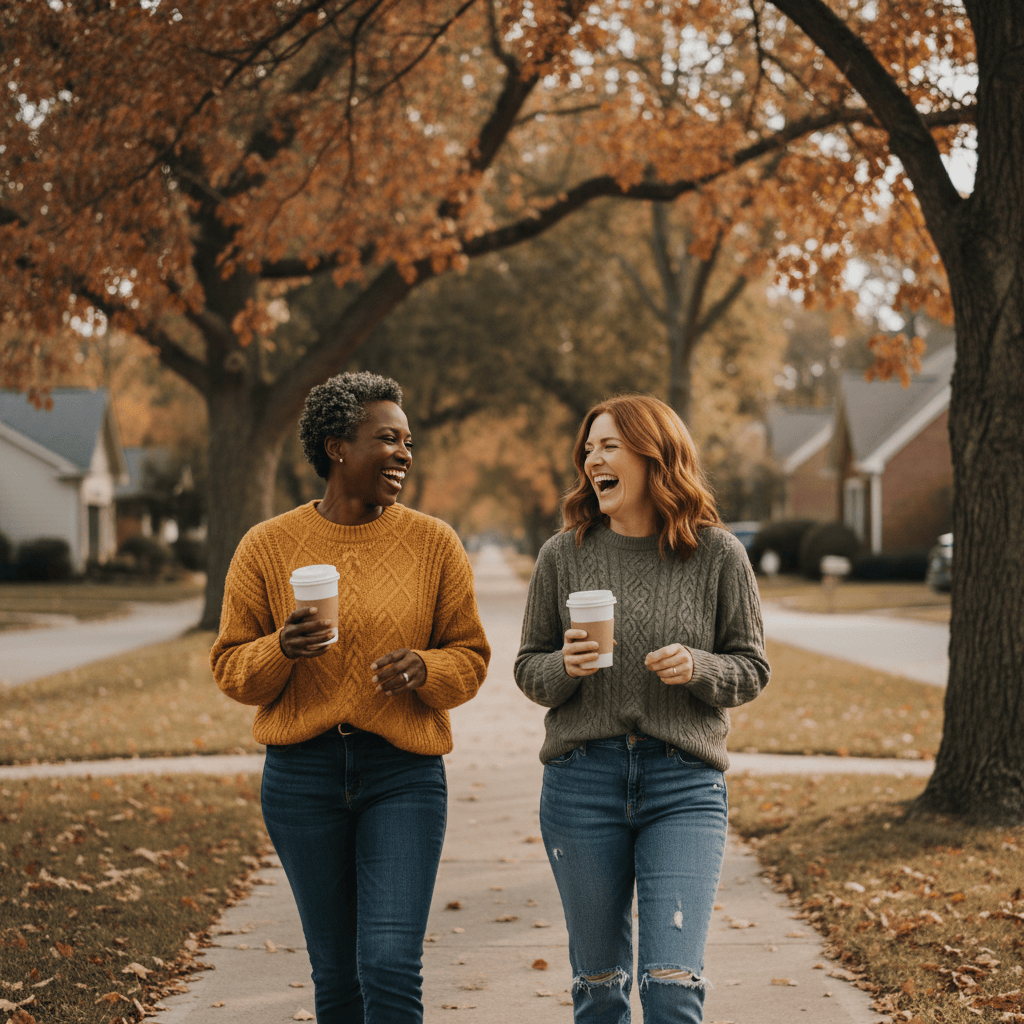
At twenty-two, friendship happened to you. At forty, you have to happen to it — and that’s not a sign something’s wrong with you.
If you’ve ever Googled something like “making friends in your 40s” at 10pm and then closed the tab out of mild embarrassment, welcome. You’re in good company, even if that company is currently also hiding in a browser tab.
Here’s the thing nobody told me: friendship in midlife takes effort. Real, scheduled, slightly awkward effort. For a long time I read that effort as evidence — that I’d missed the window, that everyone else had their people sorted and I was late to a party that had already moved to a smaller, cozier venue.
I don’t read it that way anymore.
Why Friendship Gets Harder After 30 (It’s Not Just You)
When we were younger, friendship ran on proximity and repetition. Same dorm, same lunch table, same terrible first job where we bonded over a manager who said “circle back” like it was a personality. You didn’t plan those friendships. They grew in the cracks of a shared schedule.
Then life got specific. Careers took us to different cities. Some of us had kids, some didn’t, some got divorced, some changed careers entirely. The shared schedule disappeared, and with it, the effortless overlap that used to do the work for us.
What’s left is a calendar that’s full in all the wrong ways, and a quiet loneliness that’s hard to admit when everything else looks fine from the outside. I had an inbox full of people who wanted something from me and almost no one I could text “can you talk?” without a preamble.
None of that is a personal failing. It’s what happens when the structures that used to build friendship for us quietly dissolve, and nobody hands us new ones.
Effort Isn’t a Red Flag — It’s the New Proximity
Somewhere along the way I absorbed the idea that real friendship should feel easy. If I had to try, it meant the connection wasn’t “meant to be.” Which is a lovely theory, right up until you notice you’re applying it to every single person you meet and wondering why your weekends are so quiet.
What helped me was reframing effort as the thing that replaced proximity. We don’t share a hallway anymore, so the intention has to come from somewhere else. Sending the text, picking the date, suggesting the second coffee — that’s not desperation. That’s just how friendship gets built when nobody’s assigning you a lab partner.
Making Friends in Your 40s Without It Feeling Like Networking
Most of us are excellent at networking. We know how to follow up, add value, and keep things polished. The problem is that friendship asks for almost the opposite. Here’s what’s helped me make the first move without it turning into a coffee chat with a hidden agenda:
Be specific, not polished. “We should get together sometime” is where friendships go to die quietly. “I’m going to the Saturday farmers’ market — want to come?” gives someone something to say yes to.
Lead with interest, not your résumé. Ask about the thing she lit up about, not what she does for work. Nobody ever became close friends over a job title.
Plan for the second hang, not just the first. In my experience, friendships grow through repetition. One great dinner is a nice memory. Five ordinary walks is a friendship.
Pick a recurring room. A class, a walking group, a book club, a volunteer shift — somewhere you’ll see the same faces without having to organize every encounter yourself. It brings back a little of that old proximity on purpose.
I wrote more about why these spaces matter in Why Women Need Rooms Without Agendas, and it’s still the thing I come back to: belonging grows in places where nobody’s trying to get anything from you.
When the Effort Feels Lopsided
Let’s name the hard part. Sometimes you’ll be the one who texts first three times in a row. Sometimes the plan falls through, and you’ll spend twenty minutes composing a breezy “no worries!” that took far more worry than it suggests.
That doesn’t automatically mean she doesn’t care. Midlife is full — caregiving, careers, health, kids, aging parents, all of it at once. A slow reply is often just a full life.
What’s helped me is giving each new connection a few honest tries, then letting it settle where it settles. Not every seed takes. Some friendships stay light and occasional, and that’s its own kind of good. Others surprise you by deepening when you least expect it.
If this week feels like a good one to try it, here’s a small start: pick one person you’ve been meaning to reach out to and send something specific. Not perfect. Just specific. That’s the whole first move.
Community circles are coming soon. Join the list to be first to know.


Leave a Reply